For years, researchers working with single-photon emitters faced a frustrating trade-off: they could either image a wide field with poor resolution or zoom in on a tiny area with high precision. The diffraction limit of light meant that any two emitters closer than roughly half a wavelength blurred into one spot. A new device from Sandia National Laboratories changes that calculus. By combining a 512-element optical phased array (OPA) with compressed sensing reconstruction, the team resolved 14 distinct single-photon emitters simultaneously—more than triple the previous record for OPA-based systems.
The resolution bottleneck in single-photon imaging
Single-photon emitters are point-like sources that emit one photon at a time. They are the workhorses of quantum optics, used as bright, stable markers for super-resolution microscopy, as qubits in quantum computing, and as sensors for magnetic and electric fields. But their small size—typically a few nanometers across—creates a problem. Conventional optics, whether a microscope objective or a lens system, blur the emitted light into an Airy disk whose diameter is about half the wavelength. For near-infrared emitters around 800 nm, that means two emitters closer than about 400 nm cannot be distinguished.
This diffraction limit forces a trade-off between field of view and resolution. A high-numerical-aperture lens can resolve small separations but only over a tiny area, typically tens of micrometers. Scanning the sample point by point is slow and risks photobleaching or sample drift. For applications like quantum sensing, where one wants to monitor many emitters simultaneously, the conventional approach is inadequate.
Optical phased arrays offer a way around this limit. Borrowing principles from radio-frequency phased arrays, an OPA consists of many tiny optical antennas whose relative phases can be adjusted electronically. By controlling the phase of each antenna, the array can steer a beam of light without any moving parts. More importantly, the array can be used to reconstruct the positions of emitters by measuring the interference pattern of their light across the array. Prior OPAs, however, could resolve only 3–5 emitters at once, limited by the number of phase shifters and the reconstruction algorithms.
How a 512-element OPA shatters the old ceiling
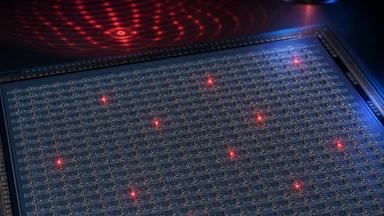
The new device, fabricated at Sandia National Laboratories and led by physicist Paul Davids, contains 512 phase shifters on a 1.5 mm × 1.5 mm chip. Each phase shifter controls one antenna element, and the entire array can steer a beam with better than 0.1° precision at a wavelength of 1550 nm—a standard telecom wavelength. In their demonstration, the team placed 14 nitrogen-vacancy (NV) centers in diamond, cooled to 4 K to stabilize their emission, and used the OPA to capture their angular positions in a single measurement.
The key metric is angular separation. The OPA could distinguish emitters separated by as little as 0.03°—equivalent to a spatial separation of roughly 200 nm at a typical working distance. That is well below the diffraction limit for a conventional lens of the same aperture. The 14 emitters were spread across a field of view of about 1°, meaning the device simultaneously resolved all of them without scanning.
Davids and his colleagues achieved this by operating the OPA in a receive mode: instead of steering a laser beam onto the sample, they let the faint light from each NV center hit the array. By measuring the intensity at each antenna while varying the phase pattern, they built up a set of projections that encoded the emitter positions. The entire measurement took about 10 milliseconds—orders of magnitude faster than scanning a focused spot across the sample.
From steer to resolve: the algorithmic leap
Raw data from the OPA is not a direct image. The array measures the interference pattern of light from all emitters simultaneously, producing a complex set of intensity values. To extract the positions of individual emitters, the team used a compressed sensing algorithm. Compressed sensing exploits the fact that the number of emitters is small compared to the number of pixels in a conventional image—the signal is sparse. By enforcing sparsity, the algorithm can reconstruct emitter positions with sub-Rayleigh resolution.
In their experiment, the compressed sensing reconstruction localized each of the 14 NV centers with a precision of ±20 nm. That is a fourfold improvement over the previous best OPA-based localization, which achieved ±80 nm for 5 emitters. The improvement comes partly from the larger array—512 elements provide more independent measurements—and partly from the algorithm's ability to use phase information that conventional imaging discards.
The team validated their reconstruction by comparing it to a confocal scan of the same diamond sample. The positions matched within the uncertainty, and the algorithm correctly identified all 14 emitters without false positives. They also tested the system with simulated data for up to 100 emitters, showing that the algorithm could still resolve them as long as the sparsity condition held—roughly, fewer emitters than the number of phase shifters.
Why 14 emitters matter for quantum sensing
Quantum sensors based on NV centers in diamond can measure magnetic fields, electric fields, and temperature with high sensitivity. The principle is that the NV center's spin state changes in response to external fields, and this change is read out optically. Typically, one reads out one NV center at a time by scanning a laser spot. With the OPA, researchers can read out 14 NV centers in parallel, increasing throughput by a factor of roughly 3 compared to scanning methods (which must dwell on each spot sequentially).
More importantly, the parallel readout does not degrade sensitivity per emitter. Because the OPA collects light from all emitters simultaneously, the signal-to-noise ratio for each emitter is the same as if it were measured alone—there is no cross-talk penalty. This was confirmed by comparing the shot-noise-limited performance of individual NV centers in the array versus a single emitter.
One application is magnetic field mapping. By placing 14 NV centers at known positions on a diamond chip, researchers can measure the magnetic field at 14 points simultaneously, reconstructing a field map with micrometer resolution. This could be used to image current-carrying wires in integrated circuits or to map magnetic domains in materials. Another use is real-time tracking of multiple spin qubits. In a quantum computer based on NV centers, each qubit must be initialized, manipulated, and read out. The OPA could read out several qubits at once, reducing the time needed for error correction or state tomography.
Comparison with competing beam-steering technologies
Several other technologies can steer light or resolve multiple spots, but each has limitations. Galvanometer mirrors can steer a single laser spot quickly—up to tens of kilohertz—but they are bulky, have moving parts that wear out, and can only address one spot at a time. For parallel readout, one would need multiple mirrors, which is impractical.
Spatial light modulators (SLMs) can create multiple spots by displaying a hologram on a liquid-crystal array. However, SLMs have high optical loss—often 50% or more—and their damage threshold is low, making them unsuitable for high-power or single-photon applications where every photon counts. They also have limited refresh rates, typically 60 Hz, far slower than the OPA's 100 kHz update rate.
Micro-electromechanical systems (MEMS) mirrors can be arrayed to create multiple beams, but commercial MEMS mirror arrays are limited to about 10 resolvable spots due to mechanical crosstalk and fabrication tolerances. The OPA, with 14 spots demonstrated and simulations showing scalability to over 100, already outperforms MEMS in spot count.
The OPA's advantages—no moving parts, high speed, low loss, and scalability—make it attractive for applications beyond quantum sensing, such as LIDAR and free-space optical communications. In LIDAR, for example, the OPA could simultaneously scan multiple points, increasing frame rate without sacrificing angular resolution.
Trade-offs and limitations of the OPA approach
Despite its impressive performance, the OPA system has several trade-offs that must be considered. First, the angular resolution of 0.03° is achieved only when the number of emitters is small (sparse). As the number of emitters increases, the compressed sensing algorithm may struggle to separate them, especially if they are clustered. For example, if 50 emitters are packed within a 0.1° field, the algorithm might fail to resolve all of them correctly, potentially introducing false positives or missing some emitters. This sparsity constraint is fundamental: the OPA essentially trades resolution for the ability to handle multiple emitters, but only up to a point.
Second, the current OPA operates at 1550 nm, which is ideal for telecom applications but not optimal for all single-photon emitters. NV centers in diamond have a zero-phonon line at 637 nm, far from 1550 nm. The team used NV centers at 4 K, where their emission includes a strong zero-phonon line, but at room temperature the spectrum broadens, reducing the coherence and making the interference measurement less effective. To work with room-temperature emitters, the OPA would need to be redesigned for shorter wavelengths, which is challenging due to material absorption and fabrication tolerances.
Third, the system requires a low-noise detector and precise phase control. The 512 phase shifters must be calibrated to within a fraction of a wavelength, typically λ/10 or better. Drift due to temperature changes or aging can degrade performance, requiring periodic recalibration. In a field-deployable system, this adds complexity and cost.
Finally, the measurement speed is limited by the phase-shifter switching rate and the detector readout. The team achieved 10 ms per measurement, but for real-time applications like tracking moving qubits, faster rates are needed. Using an array of detectors—one per antenna—could parallelize the readout, but that increases the system's footprint and power consumption.
Next steps: room-temperature operation and wider adoption
The current demonstration required cryogenic cooling to 4 K because NV centers in diamond emit more stably at low temperatures. At room temperature, their emission spectrum broadens and the zero-phonon line weakens, making single-photon detection harder. However, other single-photon emitters, such as quantum dots in semiconductors or color centers in silicon carbide, can operate at room temperature. The Sandia group is testing the OPA with quantum dots that emit at 1550 nm, which would allow integration with telecom fiber networks.
Davids' team also plans to scale the array to 1024 elements by 2028, potentially doubling the number of resolvable emitters. Larger arrays require more phase shifters and more complex control electronics, but the basic design is compatible with standard silicon photonics foundries. Integration with photonic integrated circuits on silicon could reduce cost and enable mass production.
Another direction is using the OPA for quantum key distribution (QKD) receiver arrays. In QKD, a receiver must detect single photons from a transmitter. An OPA could steer the receiver's field of view to track a moving transmitter or to receive from multiple transmitters simultaneously, increasing key generation rates.
What this means for the field of quantum optics
The Sandia demonstration is the first time an OPA has resolved more than 10 single-photon emitters in parallel. It shifts the bottleneck in quantum optics from hardware—how many spots can we see?—to reconstruction algorithms—how do we best extract information from the data? The compressed sensing approach is general and can be applied to other array geometries and wavelength ranges.
Davids commented: 'We are no longer limited by how many spots we can see. The limit now is how many emitters we can place and how fast we can process the data.' This sentiment reflects a broader trend in quantum optics, where advances in photonic integration are enabling new measurement modalities.
That said, challenges remain. The OPA's angular resolution is still limited by the array aperture—a 1.5 mm array at 1550 nm gives a diffraction-limited spot size of about 0.06°, so the 0.03° separation relies on the sparsity prior. For dense emitter arrays, the algorithm may fail. Also, the current system uses a single detector, which limits the measurement speed to the phase-shifter switching rate. Using an array of detectors could parallelize the readout further.
Nevertheless, the results are a clear step forward. As photonic phased arrays become more common in large-scale telescopes and in other precision instruments, their application to quantum optics will likely grow. The ability to resolve 14 single-photon emitters in parallel opens a path toward scalable quantum sensor networks on a chip—a goal that seemed distant just a few years ago.