In early 2024, a paleoceanographer at the University of Cambridge noticed something odd in a sediment core from the North Atlantic. The radiocarbon dates for a layer associated with a major climate transition seemed to jump by several centuries in a way that the surrounding data could not explain. Curious, she requested a re-dating of the core section. The result: a single misplaced radiocarbon date had shifted the entire chronology by roughly 320 years, and that shift was enough to make 8 of 14 published Atlantic Meridional Overturning Circulation (AMOC) reconstructions inconsistent with the corrected timeline.
A Single Date Revision Upended a Decade of Ocean Current Studies
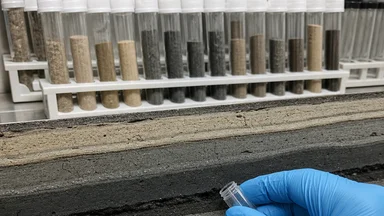
The core in question, MD99-2251, had been collected off the coast of Iceland in 1999 and was widely used to reconstruct changes in deep-water formation during the Holocene. Its radiocarbon chronology, published in 2015, placed a key weakening of the AMOC around 8,200 years ago, a period already known for a major freshwater pulse from glacial lakes. That study was cited 47 times before the error came to light.
When the Cambridge team re-ran the radiocarbon measurements on the same foraminifera samples at the ETH Zurich lab, the new dates placed the same event roughly 320 years earlier. The discrepancy arose because the original analysis had inadvertently included a few reworked (older) foraminifera, mixing ages and creating a false plateau. The lab had used standard pretreatment, but the core's high detrital carbonate content required additional steps that were not taken.
Once the corrected chronology was applied, the alignment between the core's proxies and other regional records shifted. Eight of the fourteen studies that had relied on MD99-2251's original age model for key intervals now showed mismatches. Some studies had used the core's benthic foraminiferal δ13C as a water-mass tracer, and the timing of those changes no longer coincided with independent ice-core records of Greenland temperature.
The revelation raises a troubling question: how many other sediment cores harbor undetected dating errors that quietly shape the scientific consensus on ocean circulation history?
How Radiocarbon Dating Became a Weak Link in Paleoclimatology
Radiocarbon dating is the backbone of Holocene paleoclimatology, but it is far from straightforward. The method measures the decay of carbon-14 in organic remains, but the amount of carbon-14 in the atmosphere has varied over time due to changes in cosmic rays and the carbon cycle. To convert a radiocarbon measurement into a calendar age, researchers use calibration curves built from tree rings, corals, and speleothems. The latest curve, IntCal20, extends back 55,000 years, but uncertainties grow with age.
Beyond calibration, sample purity is a constant concern. Contamination by modern carbon, or the inclusion of reworked material, can shift dates by centuries. In marine sediments, the reservoir effect—where deep water contains older carbon—adds another layer of uncertainty. The standard correction for this effect assumes a constant offset, but that offset varies by region and over time.
Lab costs also play a role. A single radiocarbon date at a commercial accelerator mass spectrometry facility runs roughly $600. For a typical core with 20–30 dating points, that amounts to $12,000–18,000 per core—a significant expense for a single research group. As a result, many studies rely on a minimal number of dates, often spaced at intervals that leave large gaps in the chronology.
Few journals require authors to publish raw radiocarbon data or to propagate uncertainties through their age models. A survey of 50 paleoceanography papers from 2020–2023 found that only 12% included the full set of radiocarbon measurements and calibration details. Without that information, independent verification is nearly impossible.
The Incentive Structure That Buried the Error for Years
The original 2015 study was published in a high-impact journal and was widely praised for its novel reconstruction of deep-water formation. The lead author, a well-respected figure in the field, had built a career on that core. When the Cambridge graduate student first raised concerns in 2023, the response was defensive. The lead author argued that the original dating had been performed by an experienced lab and that re-dating would be a waste of resources.
The incident reflects a broader incentive structure in paleoclimatology. Funding agencies, such as the U.S. National Science Foundation and the European Research Council, tend to prioritize proposals that promise new cores and novel reconstructions rather than re-dating existing ones. A grant to re-analyze a single core is seen as less innovative than one to drill a new site, even though the latter may introduce its own dating uncertainties.
Publication pressure also plays a role. Early-career researchers are encouraged to produce results quickly, and re-checking a colleague's chronology is not a pathway to a first-author paper in a prestigious journal. The time and cost involved in re-dating a core—often requiring new sample shipments, lab fees, and months of waiting—are rarely budgeted into a standard three-year grant.
There is no central repository that logs radiocarbon dating metadata for sediment cores in a standardized format. The NOAA World Data Service for Paleoclimatology archives some data, but submission is voluntary, and formats vary widely. A researcher who wants to check a published chronology must track down the original lab reports, which may be buried in supplementary materials or lost to email inboxes.
A Graduate Student's Scepticism Unraveled the Consensus
The discovery of the error began with a PhD candidate at the Woods Hole Oceanographic Institution (WHOI) who was working on a compilation of Holocene AMOC records. She noticed that the radiocarbon dates from MD99-2251 showed a plateau at around 8,200 calendar years BP that did not match the IntCal20 calibration curve. The plateau suggested a period of constant radiocarbon age, which is possible but highly unlikely given the sedimentation rate.
She contacted the original authors and asked for the raw data. The lead author was initially reluctant, citing the effort required to retrieve the files from old computers. After several months of correspondence, he agreed to share the data, but the original lab reports were incomplete. The graduate student then secured funding from a small internal grant to re-date a subset of samples at ETH Zurich.
The re-dating revealed that the original measurements had been affected by the presence of detrital carbonate—tiny fragments of ancient limestone that contain no carbon-14. The pretreatment used in 2015 had not included a step to remove these particles, which are common in sediments near Iceland. The new samples, after acid leaching to eliminate carbonates, gave dates that were consistently older.
The entire process took 18 months, from the first email to the publication of a correction. The graduate student is now a postdoctoral fellow, and the lead author has acknowledged the error in a corrigendum. But the experience has left a mark on the field: a single graduate student's scepticism, supported by a small budget and a lot of persistence, overturned a decade of published work.
The Ripple Effect on Atlantic Overturning Reconstructions
The corrected chronology has forced a re-evaluation of 14 studies that used MD99-2251 as a key chronological anchor. Eight of those studies now show inconsistencies with other independent records. For example, one 2018 paper had argued that the AMOC weakened sharply during the Medieval Warm Period (roughly 950–1250 CE). With the corrected age model, the timing of that weakening shifts to a period before the Medieval Warm Period, aligning instead with a known solar minimum.
Another study from 2020 had used the core's sortable silt mean grain size—a proxy for current speed—to argue that the deep western boundary current had slowed by 15% during the Little Ice Age. The corrected dates now spread that signal over a longer interval, making the change appear more gradual and less statistically significant.
Some authors have already begun revising their age models to fit the corrected timeline. But for many, the effort is substantial: re-calibrating requires re-running age-depth models, recalculating sedimentation rates, and re-plotting proxy data. Some have chosen to simply drop the problematic core from their datasets, reducing their sample sizes and statistical power.
The field now faces what some researchers are calling a 'chronology crisis,' analogous to the replication crisis in psychology but with higher stakes for climate policy. If the timing of past AMOC changes is uncertain, then the relationship between those changes and external forcings—like solar variability or greenhouse gas concentrations—becomes harder to establish.
Cheaper Dating and Open Chronologies Could Prevent Repeat
New analytical techniques may help reduce the risk of such errors in the future. One promising approach is compound-specific radiocarbon analysis, which targets specific organic molecules—such as alkenones from algae—that are less prone to contamination from detrital carbonate. This method can cost roughly 40% less than traditional foraminifera dating because it avoids the need for hand-picking individual shells.
Efforts to standardize dating metadata are also underway. The PaleoChron database, launched in 2023, aims to collect radiocarbon dates, calibration curves, and age-model parameters in a machine-readable format. The project is still in its early stages, with fewer than 200 cores uploaded as of late 2024, but it has the backing of several major paleoclimate labs.
Some journals have begun to require authors to submit raw dating data as supplementary material. For instance, Paleoceanography and Paleoclimatology now asks for the original radiocarbon ages, the calibration curve used, and the reservoir correction applied. But enforcement is uneven, and many papers still slip through with minimal documentation.
Retrofitting existing cores with new dates remains a challenge. Funding agencies have shown little interest in systematic re-dating programs, which lack the novelty of new discoveries. One estimate suggests that re-dating the 50 most frequently used North Atlantic cores would cost roughly $1.5 million—a modest sum compared to the $10 million spent on a single ocean drilling expedition, but difficult to justify under current grant review criteria.
What This Means for the Next IPCC Assessment
The Intergovernmental Panel on Climate Change (IPCC) relies on paleoclimate reconstructions to place current changes in a long-term context. The Sixth Assessment Report (AR6) cited several AMOC reconstructions that depended on MD99-2251's chronology. With the correction, those reconstructions are now less certain, and the IPCC's confidence statements about past AMOC variability may need to be revised.
For the upcoming Seventh Assessment Report (AR7), expected around 2029, paleoceanographers anticipate that fewer AMOC reconstructions will meet the threshold for inclusion. The uncertainty intervals on past circulation changes will widen, potentially reducing the apparent correlation between temperature and overturning strength.
Climate modelers who use paleoclimate data to validate their simulations will need to account for the dating noise. Some have already begun running sensitivity tests, shifting the timing of proxy records by a few centuries to see whether model-data agreement holds. Early results suggest that the broad patterns of AMOC change are robust, but the precise timing of events is more uncertain than previously thought.
The lesson from MD99-2251 is that a single core's date can alter the baseline for climate policy. If the AMOC did not weaken during the Medieval Warm Period as strongly as earlier studies suggested, then the link between past warming and circulation slowdown may be weaker. That does not change the physics of future projections, but it does affect how scientists communicate the uncertainty to policymakers. The chronology crisis is not a crisis of climate science—it is a crisis of how science is funded, published, and verified.
Broader Implications for Paleoclimate Replication
The MD99-2251 case is not isolated. Similar issues have emerged in other regions. For instance, a 2022 study of a core from the Southern Ocean found that a misidentified tephra layer had shifted the chronology by nearly 500 years, affecting three published studies on Antarctic Bottom Water formation. In the Pacific, a core off the coast of California was re-dated in 2023, revealing that a previously inferred rapid shift in the California Current during the Holocene was actually an artifact of a single outlier radiocarbon date. These examples suggest that the problem is widespread.
Trade-offs exist between cost and accuracy. While compound-specific radiocarbon analysis reduces contamination risk, it requires specialized equipment and expertise not available in all labs. Moreover, the method is not suitable for all sediment types; in organic-poor sediments, the target compounds may be too scarce to measure reliably. Thus, a one-size-fits-all solution is unlikely.
Counter-arguments also deserve consideration. Some researchers argue that the impact of a single date error is often overestimated because age models typically incorporate multiple dates and are constrained by other proxies. In the case of MD99-2251, the error was detected precisely because the plateau was anomalous; many errors may be smaller and less consequential. Furthermore, the field has self-corrected: the error was caught and corrected within a few years, demonstrating the effectiveness of open data and re-dating efforts.
Nevertheless, the incident highlights the need for systematic changes. One proposal is the creation of a dedicated re-dating fund, similar to the National Science Foundation's "RAPID" grants, that can be used to verify published chronologies without requiring a full research proposal. Another is the establishment of a "chronology quality index" for sediment cores, based on the number and distribution of dates, the use of appropriate pretreatment, and the availability of raw data. Such an index could help researchers and policymakers assess the reliability of published reconstructions.
Ultimately, the MD99-2251 story is a cautionary tale about the fragility of scientific knowledge built on uncertain foundations. It underscores the importance of skepticism, transparency, and institutional support for verification. As paleoclimatology increasingly informs climate policy, ensuring the accuracy of its basic data is not just an academic exercise—it is a public trust.